
There are books you read, and then there are books that read you—stories that slip beneath your skin and make a home in the chambers of your heart. Here are five books that haven’t just occupied my bookshelf; they’ve occupied pieces of my soul.
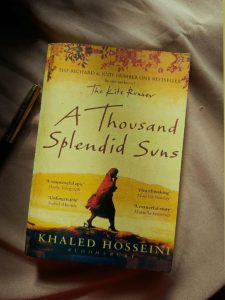
A Thousand Splendid Suns by Khaled Hosseini
The Story:
Set against the backdrop of Afghanistan’s tumultuous history, this novel follows two women—Mariam, an illegitimate child forced into marriage at fifteen, and Laila, a girl from a loving family whose life is shattered by war. Their paths converge when they both become wives to the same abusive man, Rasheed. What begins as rivalry transforms into a profound bond of sisterhood as they navigate decades of political upheaval, personal tragedy, and oppressive circumstances. Through their intertwined lives, Hosseini paints an intimate portrait of Afghanistan and an unforgettable testament to the resilience of women.
My Review:
“Like a compass needle that points north, a man’s accusing finger always finds a woman. Always.”
This line encapsulates the entire soul of the book. Every finger will turn toward women when blame is assigned, when scapegoats are needed, when the world demands someone to bear its cruelty.
This is one of those books that lives with you for life. Years after reading it, certain scenes remain vivid in my mind—none more so than Mariam’s last scene. It still gives me goosebumps. Without spoiling it, I’ll only say that it’s a moment of such profound dignity, sacrifice, and quiet strength that it redefined for me what heroism looks like.
Hosseini doesn’t just tell you about the strength of women; he makes you feel it in your marrow. Mariam and Laila’s relationship is one of the most beautiful depictions of female friendship and solidarity I’ve ever encountered. Their story is devastating and uplifting in equal measure—a reminder that even in the darkest circumstances, love and courage can bloom.
This book broke my heart and rebuilt it stronger.

Namal by Nimra Ahmed
The Story:
This epic Urdu novel spans decades and continents, weaving together mystery, romance, political intrigue, and spiritual awakening. At its center is Faris Ghazi, a brilliant and morally complex character whose journey from a troubled past to seeking justice forms the backbone of the narrative. The story explores themes of revenge, redemption, and divine justice, all while maintaining an intricate plot filled with unexpected twists. Multiple storylines converge in ways that reveal Ahmed’s masterful plotting, taking readers from the streets of Pakistan to international settings.
My Review:
Who doesn’t love Faris Ghazi?
There’s something about Nimra Ahmed’s storytelling that grips you and doesn’t let go. Namal is perhaps her finest work—a sprawling, ambitious novel that transforms with every chapter. What appears to be a simple revenge tale evolves into something far more profound: a meditation on justice, faith, and the intricate ways our lives connect.
Faris Ghazi is unforgettable—brilliant, flawed, haunted, and utterly captivating. Ahmed writes him with such depth that you find yourself simultaneously rooting for him and questioning his choices. But it’s not just Faris; every character in this novel matters. Every thread connects. Every subplot serves the greater whole.
What I love most is how Ahmed doesn’t shy away from difficult questions. She tackles corruption, social inequality, and moral ambiguity while maintaining hope in divine justice. The book is massive, yes, but every page earns its place. This is one of Urdu literature’s modern masterpieces, and if you haven’t experienced the world of Namal yet, you’re missing out on something truly special.
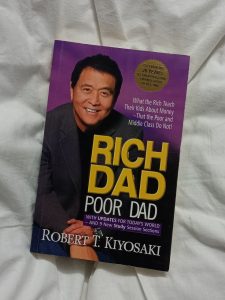
Rich Dad Poor Dad by Robert Kiyosaki
The Story:
This personal finance classic contrasts the financial philosophies of Kiyosaki’s two father figures: his biological father (Poor Dad), a highly educated man who struggled financially despite his credentials, and his best friend’s father (Rich Dad), an entrepreneur who built wealth through financial intelligence. Through anecdotes and lessons, Kiyosaki explains concepts like assets versus liabilities, the importance of financial education, making money work for you rather than working for money, and thinking like an investor rather than an employee.
My Review:
Unlike my other choices, this is non-fiction—but it deserves a place on this list because of how profoundly it shifted my perspective.
I’ve read this book only once, and once was enough. This is the kind of book that teaches you so much even if you don’t know much about finance. Kiyosaki has a gift for taking complex financial concepts and making them accessible to anyone, regardless of their background or education level.
The contrast between the “rich dad” and “poor dad” philosophies isn’t just about money—it’s about mindset. It challenges everything we’re taught about job security, education, and the “safe” path in life. The book plants seeds in your mind, and those seeds grow into entirely new ways of seeing opportunities, risks, and the relationship between work and wealth.
What struck me most was the emphasis on financial literacy as something we should all learn but schools rarely teach. After reading this, I started looking at purchases differently, thinking about assets versus liabilities, and understanding that real wealth isn’t about how much you earn but about how you manage and invest what you have.
It’s a book that empowers you to take control of your financial future.
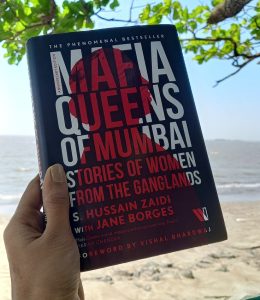
Mafia Queens of Mumbai by S. Hussain Zaidi
The Story:
This non-fiction book chronicles the lives of thirteen women who operated in Mumbai’s underworld from the 1960s through the 2000s. These weren’t women standing behind powerful men—they were the power themselves. From Jenabai Daruwali, who ran gambling dens, to Ashraf Khan, who controlled the hooch trade, to the ruthless Gangubai Kathiawadi and others, Zaidi documents how these women carved out empires in one of India’s most dangerous criminal landscapes. Based on extensive research and interviews, the book reveals the complex circumstances that led these women into crime and the cunning they employed to survive and thrive.
My Review:
Now this one is unusual, I’ll admit.
I read this book after watching a movie based on one of the women featured in it, and oh boy, did I fall in love with the other women in this book. These weren’t one-dimensional villains or simple victims—they were complex, fascinating human beings navigating impossible circumstances.
What Zaidi does brilliantly is present these women without judgment but also without romanticization. Some were forced into the underworld by poverty or betrayal. Some chose it as the only path to power available to them. Some were ruthless. Some were surprisingly principled within their own codes. All were survivors in a world that gave women very few options for agency or authority.
I found myself captivated by their intelligence, their strategic thinking, and their refusal to be invisible. These were businesswomen who happened to work in illegal enterprises. These were mothers, daughters, and sisters who wielded power in ways society told them they couldn’t.
It’s a glimpse into a world most of us will never see, told through the lives of women who rewrote the rules when the existing rules excluded them. Absolutely gripping from start to finish.
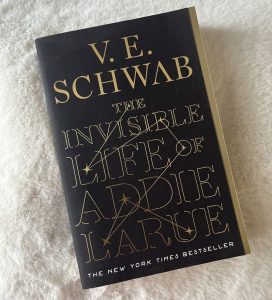
The Invisible Life of Addie LaRue by V.E. Schwab
The Story:
In 1714 France, Addie LaRue makes a desperate bargain with a god who answers after dark: she will live forever but be forgotten by everyone she meets. The moment she leaves someone’s sight, she vanishes from their memory entirely. For three hundred years, Addie survives by her wits, unable to leave a mark, unable to be remembered, drifting through history as an invisible presence. Then, in 2014 New York, she meets Henry, a bookstore worker who remembers her name. This impossible connection forces both Addie and the god she bargained with to confront what they truly want and what they’re willing to sacrifice for it.
My Review:
I loved this book. I absorbed this book. This book broke me.
It is so hauntingly beautiful that I struggle to find words adequate enough to describe it. V.E. Schwab has crafted something extraordinary here—a meditation on memory, legacy, art, and what makes a life meaningful when no one can remember you lived it.
Addie’s curse is both heartbreaking and fascinating. Imagine living for centuries but being unable to form lasting relationships, unable to tell anyone your story, unable to leave your mark on the world in any permanent way. Every friendship ends at sunrise. Every love affair is destined to be forgotten. Every attempt to write your name vanishes.
Yet Addie finds ways to live—to experience beauty, to inspire artists who won’t remember her face but might capture something she showed them, to leave invisible fingerprints on the world. The prose is lyrical and gorgeous, the romance is devastating, and the exploration of what it means to be seen, to be remembered, to matter—it cuts deep.
I found myself highlighting passage after passage, not because I wanted to remember them, but because they felt like they were written specifically for something I’d always felt but never had words for. This book is about loneliness and connection, about being invisible in a world that moves too fast to notice anyone, about the small moments that make us human.
The ending absolutely destroyed me in the best possible way. Weeks after finishing it, I’m still thinking about Addie, still carrying her story with me.
These five books are vastly different from each other—different genres, different worlds, different voices. But they share something essential: they changed me. They gave me new eyes to see the world, new language to understand human experience, new empathy for lives unlike my own.
No responses yet